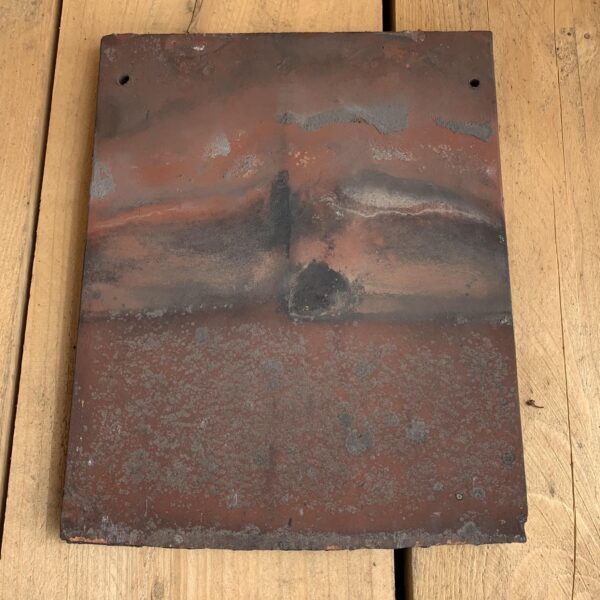
Good quality large natural red plain tiles. Unbranded but clearly a good grade of tile. Very likely to be from likely from Wray’s Brickyard York.
Lightly weathered.
Reclaimed from a North Yorkshire home. This particular home is based adjacent to the site of Wray’s Brickyard and was likely built for use by the employees.
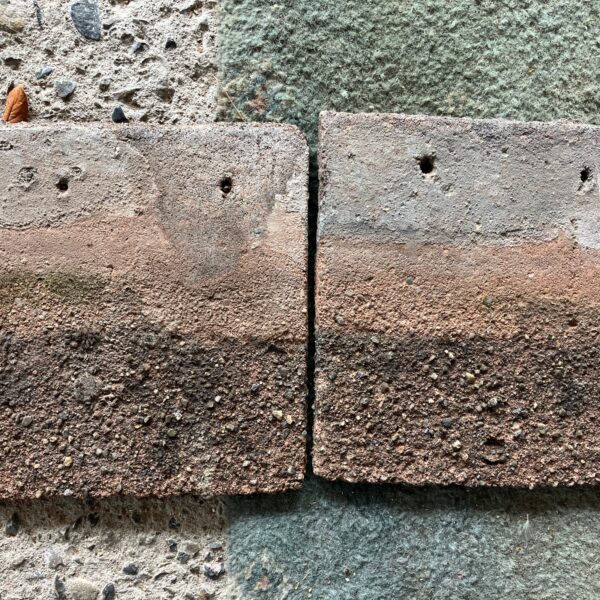
Two wide set nail holes, two nibs. Single camber.
Suitable for use as Tile and a Half on Heritage roofing projects.
Large Natural Red Plain Tile Dimensions
12″x10″ (315mm x 255mm)
Wray’s Brickyard
Wray and Moss in 1893 were builders based at 96 Lowther Street and 60 Clarence Street. They also had a brickyard at Hilda Street, off Lawrence Street. However, by 1897 Thomas Wray, who was no longer in partnership with Moss, had set up business with his sons. He set up the yard at Huntington Road, and by 1909 the yard was advertised as a ‘Steam and Machine Brickworks’. Thomas died in 1906 at the age of 75 and his obituary stated that his firm were builders, bricklayers and contractors. The firm continued until at least 1967 (Yorkshire Evening Press) when it was called ‘Wray and Sons York Facing Bricks Ltd’ and won the contract to supply bricks to build the new Music Department at the University of York.
Plain tiles use a double head lap in the same way as slates. Often made of clay and concrete and also come in a variety of colours. Concrete tiles are heavier, therefore if you use them as replacements for clay, you must determine that the roof structure can safely support the additional weight. Roofs with plain tiles generally have a higher pitch than those with other coverings
Through the ages with Plain Tiles
King Edward IV standardised the size of a plain tile in 1477 AD. The dimensions were 10½ inches by 6¼ inches by 5/8 ths of an inch thick. The British Standard for clay plain tiles first published in 1935. With only minor adjustments the British Standard remained in force until replaced by the European Standard in 1999.
Strength and Durability
Plain clay tiles offer superior strength and durability than all other roof coverings. Many examples exist of roofs with plain clay tiles that are still standing in pristine condition after more than 100 years. The permanence of the colour with naturally burnt clay colours guarantees that the roof will never look washed out and as it ages it will also improve and mellow.
Colour
The overwhelming case for plain clay tiles rests upon aesthetics. A wide range of natural burnt colours; Burnt Red, Brown as well as Blue are available. It is not possible to match with artificial colouring. Artifical colours permanence is not guaranteed unlike clay tiles.
Versatility
The small size of plain clay tiles provides the versatility for the architect to design roofscapes of infinite interest. Large format roof tiles simply do not offer this flexibility.
Sustainability
Plain Clay tiles are a sustainable product. The longevity of clay means that not only the energy but the raw materials used in their production are offset over the whole life of the roof. Also most clay tile roofs survive over 100 years.





Reviews
There are no reviews yet.