

Concrete roof tiles, informative posts, Reclaimed Roof Tiles
Reclaimed Concrete Roof Tiles | The Ultimate Guide
May
Concrete roof tiles
The Ultimate Guide to Reclaimed Concrete Roof Tiles
Buy and sell reclaimed concrete roof tiles with The Reclaimed Company while supporting circular reuse of second-hand building materials from Yorkshire and beyond.
Concrete roof tiles have shaped huge areas of British housing, especially across post-war estates, suburban developments and later refurbishment schemes. Today, reclaimed stock plays an important role in repairs, matching work, extensions and sustainability-led roofing decisions.
The Reclaimed Company presents
Why Reclaimed Concrete Roof Tiles Matter
Concrete roof tiles remain one of the most recognisable roofing materials in the UK. They appear on countless houses built from the mid-20th century onward, and many of those roofs now need repair, alteration or careful extension work. In those cases, reclaimed concrete roof tiles often provide the best answer.
New equivalents may look close at first glance. However, they rarely match the existing roof perfectly. Differences in pigment, surface finish, weathering, profile detail and overall age tend to stand out quickly once installed. That is why reclaimed stock has become increasingly valuable.
In simple terms: reclaimed concrete roof tiles help you match an existing roof more convincingly, reduce waste, and retain the visual character of the building far better than most brand-new replacements.
Why Choose Reclaimed Concrete Roof Tiles?
There are several good reasons to choose reclaimed concrete tiles instead of reaching immediately for new replacements.
For many homeowners and roofers, the decision is not just about sentiment. It is about getting the finished roof to look right.
A Brief History of Concrete Roof Tiles
Concrete roof tiles became especially popular in the early and mid-20th century, then expanded rapidly after the Second World War as housing demand surged. Manufacturers produced them at scale because they offered affordability, fire resistance, strength and relative ease of installation.
By the 1950s, 1960s and 1970s, concrete tiles had become a defining feature of many British housing developments. Different profiles, moulds and colour ranges appeared across the market, which is why matching older roofs today often depends on identifying the original manufacturer and tile type correctly.
Well-known names associated with this part of the market include Redland, Marley, Russell Roof Tiles, Sandtoft and Ludlow.

Concrete tiles may be common, but matching the right profile, age and colour still requires real care and proper stock knowledge.
Types of Reclaimed Concrete Roof Tiles
The reclaimed market includes a wide variety of concrete tile profiles. Some are extremely common, while others are more niche or tied to a particular era of housebuilding.
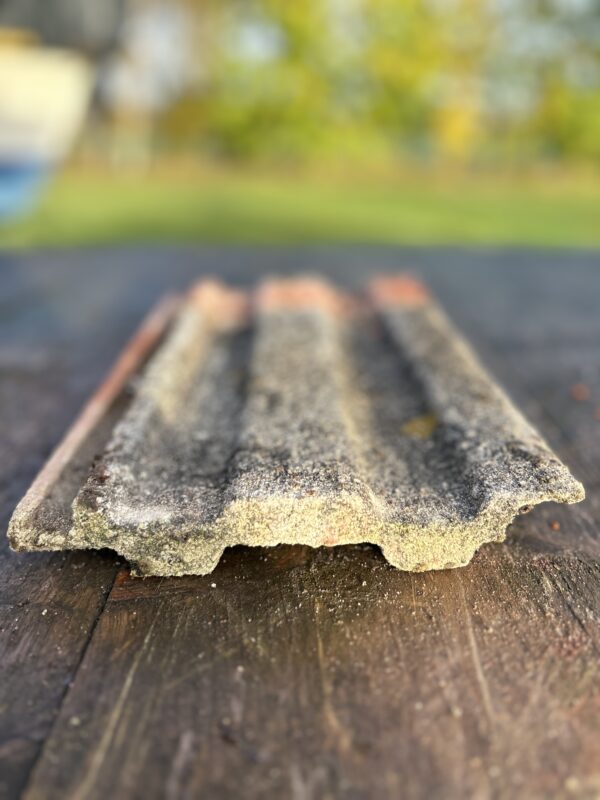
1. Double Roman
Profile: two rolls and two valleys, creating a strong undulating appearance.
Typical use: widely seen on post-war and later suburban housing, particularly where a traditional but economical roof finish was required.
Common colours: red, terracotta, brown and grey variants.
2. Flat Concrete Tiles
Profile: flatter visual appearance, sometimes smooth and sometimes lightly textured.
Typical use: common on later modernist and more contemporary housing styles, especially where a sharper roofline was preferred.
Common colours: charcoal, slate grey, brown and weathered tones.
3. Ludlow Major
Profile: a subtly curved concrete profile strongly associated with later 20th-century estate housing.
Typical use: highly useful for repair and matching work on 1970s, 1980s and 1990s homes.
Common colours: antique brown, brindle, red and grey.
4. Redland 49
Profile: a flatter tile with slight camber, widely recognised across British housing stock.
Typical use: one of the classic post-war concrete tiles, often required for repairs on mid-century roofs.
Common colours: grey, red and brown variations.
5. Stone-Effect Concrete Tiles
Profile: moulded to echo the look of more traditional stone coverings.
Typical use: often chosen where planners, designers or homeowners wanted a more traditional look without the cost and weight of real stone.
Common colours: buff, weathered grey and stone-effect finishes.
Need to match an existing concrete roof?
The best results usually come from comparing profile, size, colour tone and degree of weathering together rather than focusing on just one feature.
Manufacturer Deep Dive
Redland
Redland helped define the mass-market concrete roofing era. Their older tile profiles remain some of the most frequently sought after in the reclaimed market, especially for repair work.
Marley
Marley’s tile ranges, including Ludlow-related profiles, remain a major part of the reclaimed matching market thanks to their widespread use across UK housing developments.
Russell Roof Tiles
Russell products appear regularly on municipal, housing and commercial roofs, making them relevant for both practical repairs and larger matching exercises.
Sandtoft
Although many buyers associate Sandtoft strongly with clay, the brand also forms part of the wider historic concrete-tile picture in the reclaimed market.
Ludlow
Ludlow-related profiles became a familiar sight on later 20th-century housing and are still one of the most common tile requests for extension and patching work.
Mixed legacy stock
Many roofs contain products from eras when manufacturing changed subtly over time, so identification often depends on experience as much as branding.

Sorting and grading matter because even common concrete tiles can vary by era, batch, manufacturer and weathering pattern.
Colour Variations and Weathering
Concrete tiles were produced in a wide range of pigmented colours, including red, terracotta, grey, brown, brindle and buff tones. However, the colour you see on the roof today is rarely the exact colour that left the factory.
Years of exposure to sun, rain, frost, airborne dirt and organic growth change the finish dramatically. This weathering is one of the main reasons reclaimed tiles are so useful. They carry a visual maturity that new tiles simply do not yet have.
As a result, matching is not just about choosing “grey” or “brown”. It is about choosing the right grey or brown in the right profile and the right stage of ageing.
Where Reclaimed Concrete Tiles Work Best
Roof Repairs
Small-scale repairs often look poor when new tiles are inserted into an older roof. Reclaimed stock helps those patch repairs disappear more naturally.
Extensions
If the roof on an extension fails to match the main house, the new work can look visually disconnected. Reclaimed concrete tiles help preserve cohesion across old and new roof slopes.
Refurbishment Projects
Large-scale refurbishments often need a middle ground between total reroofing and minor repair. Reclaimed tiles make that balance easier by keeping appearance and performance aligned.
Visually Sensitive Sites
Even where full heritage controls do not apply, many streets and neighbourhoods benefit from roofs that do not jar with the surrounding built fabric. Reclaimed stock can be very useful in these settings.
Why Modern Equivalents Often Fail to Match
Many buyers assume that a current manufacturer’s “similar” tile will solve the problem. In reality, that often leads to disappointment.
- Pigmentation differs: new production methods and colour mixes rarely age in the same way as older tiles.
- Dimensions shift: even slight variation affects coursing, gauge and visual rhythm on the roof.
- Profiles evolve: manufacturers alter moulds over time, sometimes only subtly, but enough for the mismatch to show.
- Finish changes: older tiles have established wear patterns and muted surfaces that new stock lacks.
That is the real value of reclaimed stock: it is not just second-hand material. It is often the only realistic route to a visually convincing repair.
Sourcing and Selecting Reclaimed Tiles
At The Reclaimed Company, reclaimed concrete tiles are selected and organised with matching in mind. That means looking beyond simple category labels and paying attention to the details that matter on site.
- Tiles are sorted by profile and type.
- Colour and weathering are considered as part of the matching process.
- Sound, serviceable stock is prioritised.
- National delivery helps buyers source harder-to-find matching tiles without relying only on local yard availability.
Where needed, the practical route is often to send photographs or samples and compare against known reclaimed stock. That approach is usually far more reliable than guessing from memory.
Installation Considerations
Reclaimed concrete tiles are practical materials, but they still need thoughtful installation. Matching repairs properly means checking more than appearance alone.
Check soundness
Only serviceable tiles should go back onto the roof. Inspection remains essential even where the batch looks visually right.
Confirm fit and gauge
Profile, size and coursing all need to work with the existing roof if the repair is going to perform and look correct.
Use experienced installers
Roofers familiar with matching work and reclaimed materials usually achieve the best visual and technical outcome.
The Future of Reclaimed Concrete Roof Tiles
The future for reclaimed concrete tiles looks strong. As the building industry places greater emphasis on reuse, carbon reduction and material recovery, the logic of salvaging sound roofing stock only becomes clearer.
Concrete tiles are especially well suited to reclamation because many remain structurally serviceable long after the buildings they came from have changed use or been altered. That creates an excellent opportunity to keep practical roofing materials in circulation rather than allowing them to become waste.
Selected Image Context


